Key Takeaways
- 1.Document review is now table stakes. Differentiation lies in information collection, completeness checks and quality control.
- 2.The next diligence advantage is knowing what to ask and identifying what is missing, not producing faster summaries.
- 3.Document-based diligence leaves a separate question unanswered: how the people responsible for integration will operate under pressure.
- 4.AI output can appear complete even when critical inputs are missing. Human interpretation and deal context remain essential.
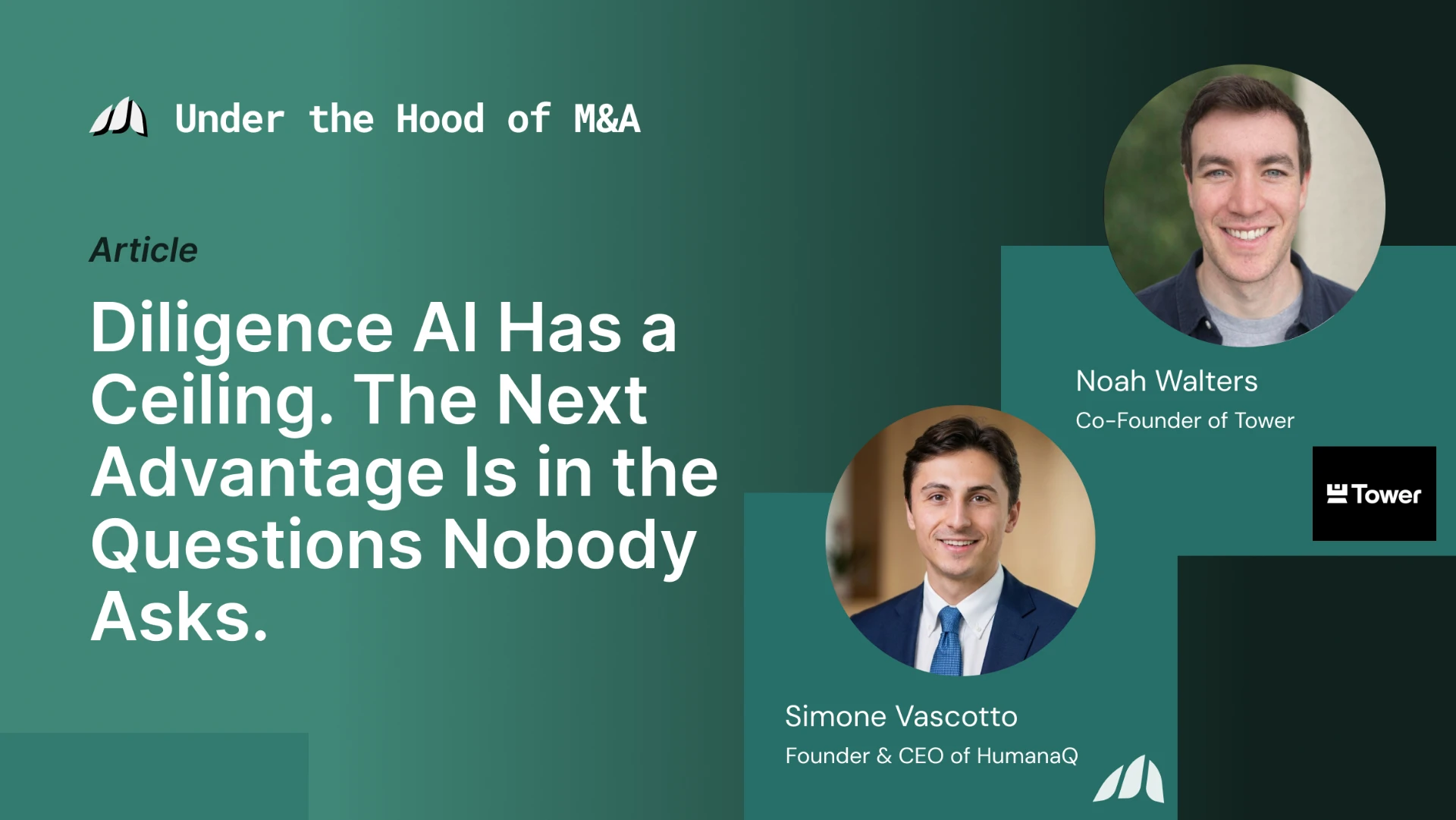
I spoke with Noah Walters, M&A lawyer and co-founder of Tower, an end-to-end diligence platform. Here's what I'm taking away from our conversation on the future of AI in M&A diligence.
Two years ago, tools that could extract bulk text from documents and match it against defined terms felt like a genuine advancement. Today, that's table stakes.
"If you can’t pull natural language answers to specific questions across large volumes of documents, you're not a diligence product today."
The capability that felt revolutionary eighteen months ago is now the minimum bar to compete. Most of the market is still fighting over features that no longer differentiate anything.
Where the real differentiation has moved
Platforms no longer separate on the review itself. They separate on everything wrapped around it: how you collect information, how you confirm you're reviewing the right materials, and how you quality-control AI output before it becomes a deliverable.
"Contract review on its own is ultimately an efficiency gain. It can make lawyers faster at one part of a transaction, but it doesn’t fundamentally change how the broader deal process operates.”
This is interesting to consider for anyone evaluating AI diligence tools right now. A platform that reviews documents well is solving one part of a much longer workflow. The gap most buyers don't notice until they're deep into implementation is what happens before the review (making sure you've collected the right materials) and after it (turning AI output into something an investment committee can actually trust).
The direction diligence is heading
Where diligence goes next is not about faster document summarization. Noah talks about questions.
"The future of diligence is going to be rooted in the negative. How do we infer risk and understand the strategic intentions of the potential seller?. How do we meaningfully reconcile diligence findings with the buyer’s goals post-close?"
Generating a memo or a report is going to keep getting better and cheaper. What won't commoditize as easily is knowing what to ask. A seller's goal in diligence is presenting information favorably, sometimes concealing what's unfavorable without technically breaching the agreement. Catching that requires reading signals that aren't always in the documents.
"That can be how somebody responds on a call, how much time they take before getting back to you about something that seems trivial."
There's a legal mechanic behind this. In North American deals, simply putting information in the data room generally doesn’t amount to disclosure against the seller’s representations and warranties. The important exceptions need to be surfaced and captured through the diligence process and ultimately in the disclosure schedules. That means summarizing what’s already in the room only gets you so far - good diligence also requires knowing what to ask, so issues are surfaced explicitly and a seller can actually be held to their answer.
Where this connects to behavioral risk
Noah's framing is about inference, catching what a seller isn't saying, reading response latency and evasiveness as signal. The behavioral diligence framing is about a related but distinct problem: once you're past the deal and into integration, how do you know whether the people responsible for execution can actually work together?
Both are pointing at the same underlying limitation of document-based diligence. A data room tells you what a company has done. It tells you almost nothing about how the people running it actually operate under pressure, whether two leaders see eye to eye, or where the fit is strong versus where there's real distance that no financial model captures.
Recorded pre-diligence and diligence calls, transcribed and analyzed, could feed both of these needs simultaneously: surfacing evasiveness that predicts undisclosed risk, and surfacing behavioral compatibility that predicts post-close execution risk.
Where he thinks agents actually go
Two possible futures.
In one, sell-side teams deploy an agent to pull all relevant content directly out of their internal systems, so a very small executive team can run an entirely private disposition process, getting brief inputs from department heads along the way, without a traditional broad effort.
In the other, buy-side agents interact directly with sell-side agents, exchanging diligence questions and answers against underlying documents, with no human reviewing those documents.
"In that world, maybe it's a list of 9,000 diligence questions that these agents send to the seller rather than human’s reviewing any documents at all, with nearly instantaneous results triaged to humans for interpretation"
He's careful to flag this as speculative. But the underlying point holds regardless of whether it fully arrives: the volume ceiling on diligence review isn't the constraint anymore. The constraint is what context you feed the process and what you know to ask.
The actual bottleneck right now is not the technology
It's not a model capability. It's the humans behind the tech. Most people don't know how to prompt properly. They don't know how to feed tools with accurate context and the real limitation may rather be education.
When Tower ingests information it instantly scans it for deficiencies, and gaps against diligence questions, so that when humans and AI agents review they do so on reliable data, with full deal context. Tower's product response with respect to the review itself is also instructive for anyone building or buying in this space: rather than expecting users to write good prompts, they automatically generate a more sophisticated prompt structure when a user starts typing, and let teams share ‘optimized’ prompt templates across the organization. The design philosophy is to make the tool resilient to a mediocre prompt rather than assuming the user will improve.
The second limitation he raised is more consequential and less discussed: AI tools currently exhibit a kind of false confidence. They don't know what they don't know, but they present outputs as complete regardless.
"If the data room is missing a section on litigation, it's still going to give you a diligence report, and it's probably not going to flag that it didn't ask any questions about pending litigation, which could be a massive red flag."
This is the exact same failure mode that shows up whenever any AI system is asked to work from incomplete inputs and doesn't flag the gap. In a diligence context, this gap can be a serious cost. A missing litigation disclosure that never gets flagged because the model doesn't know to ask about what isn't there is precisely the kind of miss that turns into a post-close surprise measured in the tens of millions.