Key Takeaways
- 1.AI excels at high-volume, pattern-dependent tasks: contract review, pipeline scoring, scenario modelling, and early integration drafting.
- 2.Human judgment remains irreplaceable in cultural due diligence, relationship building, nuanced negotiation, and the final go or no-go decision.
- 3.The failure mode is adopting AI without mapping which decisions belong to the algorithm and which belong to the person. Speed of adoption is not the issue.
- 4.Three guardrails keep the hybrid model safe: sequence workflow design before tooling, enforce explainable AI, and keep human experts validating outputs.
Short answer
AI is not here to substitute the adviser's judgment. It is here to expose it. Bring structure and expertise to the process and AI becomes a force multiplier. The question is not whether to use it. It is knowing precisely where to deploy it and where to keep humans firmly in the seat. Get that division wrong and you either leave speed on the table or, worse, let an algorithm make a call that requires judgment it does not have.
The core distinction
Some tasks are high-volume, pattern-dependent, and time-consuming. Contract review across thousands of pages. Pipeline scoring across thousands of targets. Scenario modelling across thousands of variable combinations. These do not require judgment. They require processing. AI wins on speed, scale, and consistency.
Other tasks are low-volume, context-dependent, and relationship-intensive. Understanding why a founder will not sell without retaining the rights to a piece of hunting land. Reading the hesitation in a negotiation. Deciding whether a behavioral gap between two commercial teams is large enough to kill a revenue synergy. These require situational intelligence that models do not have.
The failure mode in most AI-assisted deal processes is not adopting AI too aggressively. It is adopting it without mapping these two categories first. Technology only works if the team knows what good execution looks like. Design the process before you layer in the tools to accelerate it.
Where AI takes the wheel
Contract and document review. NLP tools reduce review times by up to 80%, flagging change-of-control provisions, anomalies, and compliance risks across thousands of pages instantly. The work that previously consumed weeks of associate time compresses to hours.
Outside-in pipeline management. Rather than static target lists updated quarterly, AI continuously scans public sources, scores targets against thesis criteria, and surfaces workforce structures, spending profiles, and labor cost estimates before a formal bid is submitted. The operational point: you understand the target's cost base before they know you are looking.
Early integration drafting. Generative AI produces first drafts of integration workplans, transition service agreements, and checklists at a fraction of the manual drafting time. Bain's research puts the compression at 25% for standard administrative preparation.
Scenario simulation. Digital twins allow AI to run thousands of what-if simulations against financial models simultaneously, stress-testing cash flows, tax exposure, and supply chain dependencies against rate shocks and market disruptions.
Where human judgment is non-negotiable
Cultural and ethical due diligence. AI can analyze employee sentiment surveys. It cannot replicate the qualitative, context-specific assessment of how a leadership team actually operates under pressure. Face-to-face conversation remains the only mechanism for understanding whether the people you are buying will stay and execute.
Psychology, trust, and relationship building. Proprietary deals are built on personal relationships. Real-world deal blockers are often discovered in conversation, not data rooms. A founder's attachment to a local sponsorship or a family-owned company vehicle can kill a deal that looked clean in the model. No algorithm detects this.
Nuanced negotiation. Negotiation is psychological. Human negotiators read the room, interpret hesitation, adapt in real time, and sense when the other side's stated position does not reflect their actual priority. AI can propose options. It cannot sit across a table.
Strategic decision velocity. AI produces recommendations. Humans make the call. The most valuable deal insights still come from experienced practitioners reading between the lines of a commercial contract or a board minute. That remains irreducibly human.
The matrix
The table below maps these distinctions across the five core diligence workstreams: financial and tax, legal and compliance, commercial and market, technology and IP, and human capital and culture. For each workstream it identifies where AI should take the wheel, where human intervention is required, and the specific risks and safeguards practitioners need to enforce.
| Workstream | AI takes the wheel | Humans lead | Risk to enforce |
|---|---|---|---|
| Financial and tax | Scenario modelling, tax exposure stress tests, anomaly detection | Judgment on go/no-go assumptions, IC presentation | Model hallucination, over-reliance on automated forecasts |
| Legal and compliance | Contract review, clause extraction, change-of-control flagging | Interpretation of intent, negotiation strategy, regulatory judgment | Missed contextual risk, mischaracterized liability |
| Commercial and market | Pipeline scoring, market scanning, spend profiling | Customer relationship assessment, synergy thesis validation | False positives, misunderstood customer dynamics |
| Technology and IP | Code review, IP landscape mapping, technical debt quantification | Strategic fit, integration sequencing, team capability | Overstated technical readiness, underestimated integration cost |
| Human capital and culture | Behavioral and execution intelligence, survey processing, workforce structure mapping | Interpersonal cues, leadership alignment, retention judgment | Treating culture as a data set rather than an execution risk |
Read each row as a handoff point, not a competition. AI's job is to compress the sifting work so your team spends more time on the judgment calls that actually move deal outcomes. If a workstream in your process has AI making a decision that belongs in the human-led column, that is a process gap worth fixing before it costs you post-close.
Three guardrails for the hybrid model
Sequence workflow design before tooling. Acquirers must first design their M&A processes, establish their value drivers, and map their operating models before layering in technology to accelerate them. Tools that run ahead of a defined process generate administrative noise rather than deal intelligence.
Enforce explainable AI. Executive boards and investment committees cannot rely on black box decisions. Mature teams implement XAI frameworks ensuring that AI-driven recommendations, risk logs, and synergy calculations are traceable, transparent, and defensible. If you cannot explain to the IC why the model said what it said, the output should not be in the room.
Active human-in-the-loop oversight. AI-generated outputs must be validated by human subject-matter experts before they are acted on. In high-stakes compliance and valuation assessments, a hallucinated clause or a mischaracterized business structure is not a minor error. It is a material liability.
The one question that cuts through all of it
Can AI ever make the final go or no-go call on a deal?
No. AI compresses each workstream from weeks to hours. But the go or no-go decision synthesizes financial, legal, commercial, technology, and human signals into one judgment call. That synthesis is still irreducibly human.
The most advanced deal processes in the market right now are not the ones with the most AI tools. They are the ones where practitioners have been most precise about which decisions belong to the algorithm and which belong to the person across the table.
That precision is the competitive advantage. Not the tooling.
About the Author
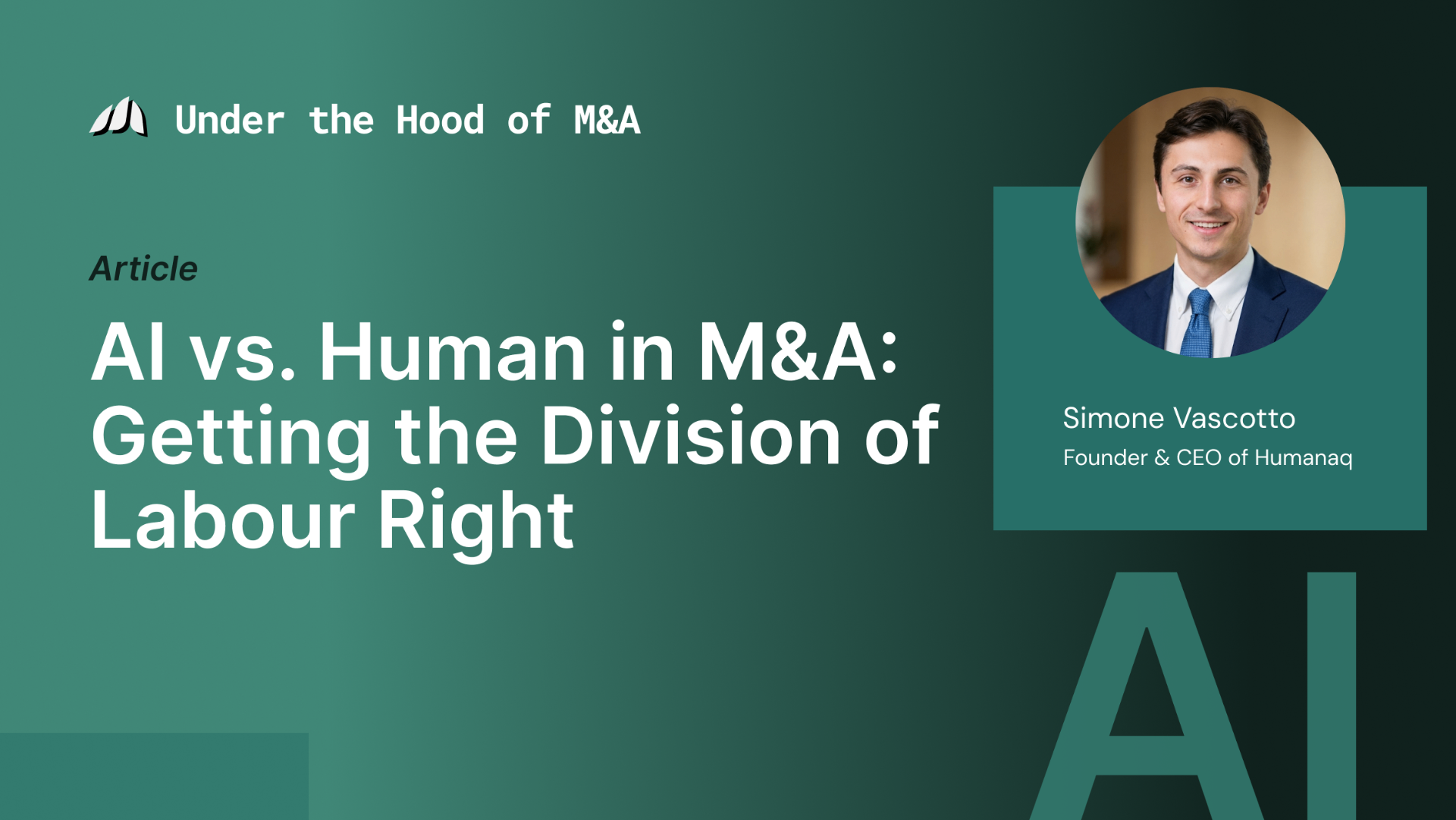
Simone Vascotto is the Founder of HumanAQ, the AI-powered platform for Cultural Due Diligence and leadership alignment in M&A.